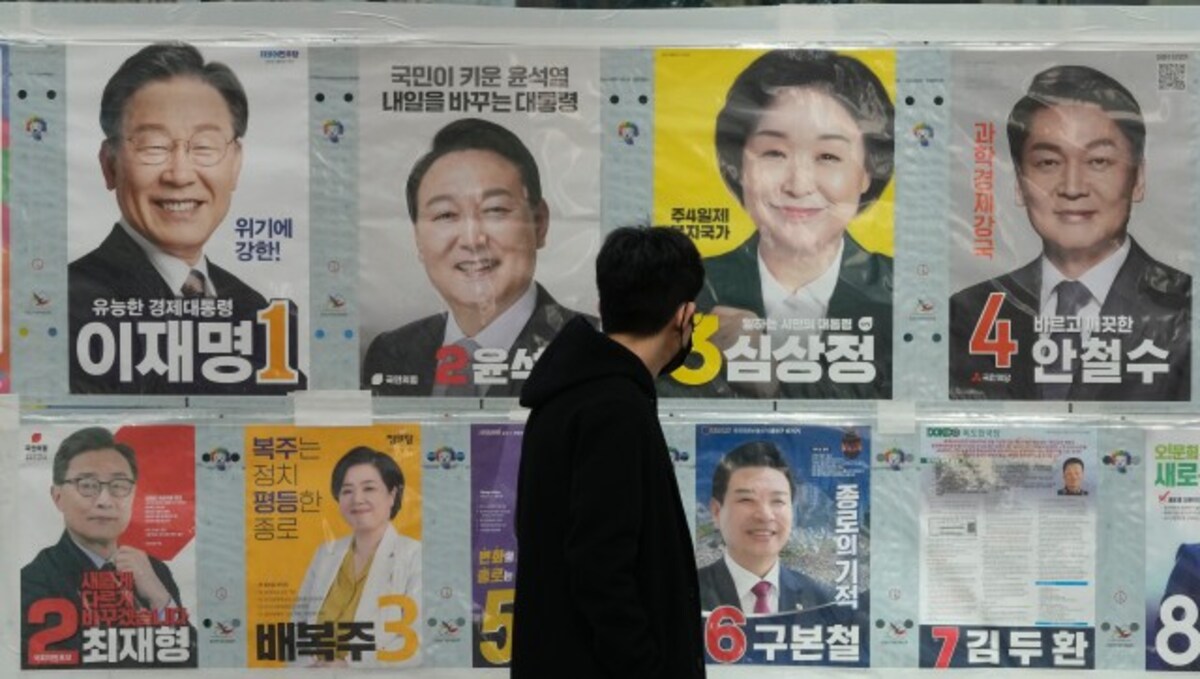
South Korea presidential election 2022


SEOUL, South Korea – Exit polls showed the two leading candidates in dead heat as voting ended on Wednesday, March 9, in South Korea’s presidential election to decide the country’s leader for the next five years.

Conservative Yoon Suk-yeol, with 48.4%, was slightly ahead of liberal Lee Jae-myung, with 47.8%, an exit poll jointly conducted by three television networks showed. Another poll by broadcaster JTBC showed Lee ahead with 48.4%, to Yoon’s 47.7%.

The campaign was marked by surprises, scandals, and smears, but the policy stakes are high for the populace of 52 million.

The winning candidate must tackle challenges such as the effects of South Korea’s worst wave of COVID-19 infections, growing inequality, and surging home prices while navigating an increasingly tense rivalry between China and the United States.

Voters also seek a leader who can root out graft and pursue negotiations to curb North Korea’s nuclear ambitions.

Lee, the standard-bearer of the ruling Democratic Party, and Yoon, from the conservative main opposition People Power Party, are vying to succeed incumbent President Moon Jae-in, who is constitutionally barred from seeking reelection. 

Source: Rappler.com

Popular posts from this blog

"What do you do?" in a business context

  Vocabulary 1. Professionalism - refers to the level of competence, conduct, and behavior expected of individuals in a business setting. 2. Responsibilities - duties or tasks that an individual is expected to perform within their role or position in a company. 3. Accomplishments - notable achievements or successes that an individual has accomplished within their job or industry. 4. Jargon - specialized language or terminology used within a specific industry or profession that may not be easily understood by those outside of the industry. 5. Efficiency - the ability to perform tasks or complete projects in a timely and effective manner, while using resources wisely and minimizing waste. Comprehension Questions 1. Why is the question "What do you do?" commonly asked in a business context? 2. What is the importance of introducing oneself when answering the question "What do you do?" 3. What should be the focus when answering the question "What do you do?" in...

How Korean culture became a global phenomenon

Part 1. Vocabulary phenomenon /fəˈnäməˌnän,fəˈnäməˌnən/ n - a remarkable person, thing, or event The band was a pop phenomenon just for their sales figures alone.   descent /dəˈsent/ n - the origin or background of a person in terms of family or nationality My best friend has Asian descent, her family is from India.   impression /imˈpreSHən/ n - an effect produced on someone Her courtesy and quick wit had made a good impression on me.   conglomerates   /kənˈɡlämərət/ n - a large corporation formed by the merging of separate and diverse firms. I want to work on a media conglomerate.   receptive /rəˈseptiv/ adj - willing to consider or accept new suggestions and ideas. The concert was so fun because of the receptive audience.         ...

California to Erect Solar Panels over Canal to Save Water from Evaporation

  Some scientists and engineers believe that covering California’s irrigation canals saves it from drought and that they could meet the state’s renewable energy commitment. Vocabulary erect /əˈrek(t)/ v. construct; put up: Ex: “California erects solar panels…”   vegetative /ˈvejəˌtādiv/ adj. relating to vegetation or plant life: Ex: “reduce vegetative growth”   drought /drout/ n. a long period of low rainfall, leading to water shortage: Ex: Irrigation canals are saved from drought.   panels /ˈpan(ə)l/ n. a flat or curved component, typically rectangular, that forms or is set into the surface: Ex: The panels could prevent 65 billion gallons of freshwater loss.   arrays /əˈrā/ n. an ordered series or arrangement; Ex: Several arrays of solar panels will help provide power.   Comprehension Questions ...